

- Prompts structured responses ranging from hydration reminders and shaded rest areas to mandatory work-rest cycles of a minimum 10 minutes per hour when heat thresholds are exceeded 320C.
- Real value of AI-led heat stress management is not in identifying extreme conditions but in intervening before those conditions translate into incidents
On most construction sites in Singapore, heat doesn’t arrive as a sudden threat, but it builds gradually, almost unnoticed.
For instance, when a worker continues under the sun a little longer than planned, or a water break gets delayed. Fatigue does set in, but not enough to stop work immediately. And in that slow build-up, risk begins to take shape.
What makes heat stress particularly challenging is that it affects concentration, slows reaction time, and increases the likelihood of small mistakes.

As per the guidelines by the Ministry of Manpower (MOM), companies are now expected to monitor Wet Bulb Globe Temperature (WBGT) levels throughout the day and implement structured responses ranging from hydration reminders and shaded rest areas to mandatory work-rest cycles of a minimum 10 minutes per hour when heat thresholds are exceeded 320C.
Employers are also required to ensure workers are properly acclimatised, trained to recognise early symptoms, and supported with immediate access to rest and recovery when needed.
These measures mark a clear shift—from general awareness to active, enforceable heat risk management. But even with these frameworks in place, one question continues to surface on the site:
How do you ensure the right action happens at the right moment?
Reality of managing heat on live site
In practice, heat stress management is still largely structured around planning and supervision.
Supervisors monitor WBGT readings at intervals, breaks are scheduled based on guidelines, workers are briefed during toolbox talks, and water stations are made available. All of this is essential and, in many cases, well implemented too.
But construction sites are dynamic environments. Work intensity changes throughout the day. Exposure varies depending on location and task, while workers often push through discomfort to complete what they’ve started.
Between scheduled checks and planned breaks, there are long stretches where conditions change, but visibility remains low. A worker may begin to experience early fatigue well before the next scheduled rest period. Another may skip hydration unintentionally while focusing on a task. These are small gaps, but they are where risk begins to accumulate.
The challenge here is the gap between guidelines and real-time execution.
The changes it brings
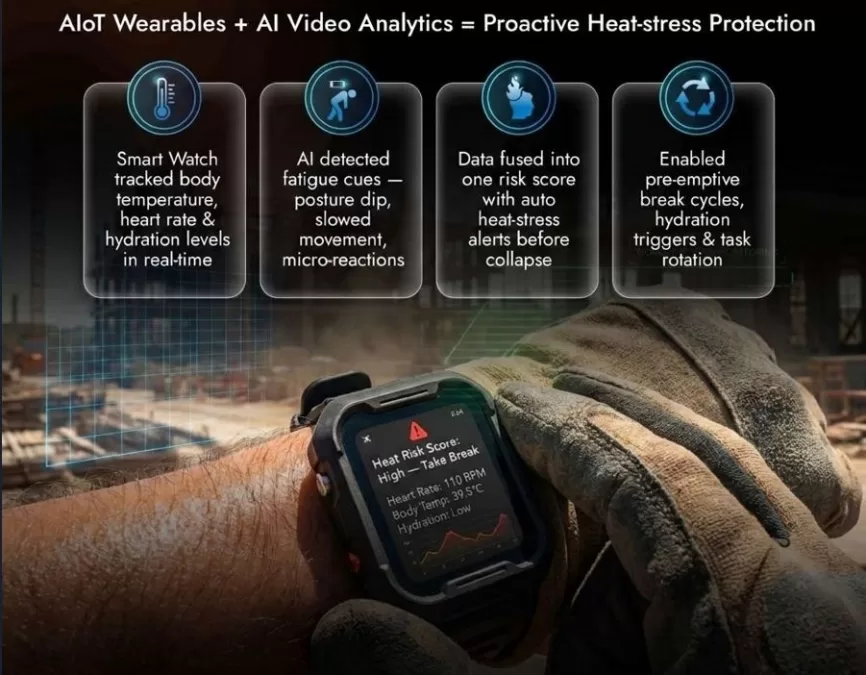
To address the dynamic reality of a site in motion, viAct Technology Pte Ltd, a Singapore-based technology company, has initiated a pilot that brings together AI-enabled CCTV systems and industrial smartwatches to manage heat stress in Singapore more proactively.
The premise is straightforward.
Existing CCTV cameras across the site already observe daily operations, but now with an added layer of AI intelligence. From tracking worker movement, activity patterns, to environmental exposure, activities are now coupled with contextual data such as temperature thresholds and duration of exposure. These AI systems begin to identify when a worker may be approaching a risk threshold.
But detection alone is not enough. What matters is whether the system can respond immediately and directly.
In this model, when heat-related risk is identified, the system does not wait for a supervisor to intervene or for the next scheduled check.
Instead, the worker’s smartwatch delivers a quiet, haptic alert—a vibration on the wrist accompanied by a simple instruction:
There is no disruption to the rest of the site. No alarms or announcements. Just a timely, personal prompt that reaches the worker when it matters most.
Real behavioural change
One of the persistent challenges in safety management is verifying whether protocols are followed consistently. Heat stress guidelines can be clearly defined, but adherence often varies depending on workload, urgency, and site conditions.
With integrated AI and wearable systems, this becomes more visible. Each alert, response, and corrective action is recorded. Over time, this creates a clear dataset of actual behaviour on site.
This extends beyond heat stress alone. The same system begins to surface patterns across overlapping risks, whether it is a lone worker spending extended time in an isolated zone, delayed response to fatigue indicators in high-temperature environments, or abnormal inactivity that could signal a fall or distress event.
Safety teams can begin to understand:
- How frequently workers reach high exposure levels
- How quickly interventions are triggered
- How consistently workers respond to alerts
Equally important is that these insights do not remain fragmented. When integrated with existing control and monitoring systems, they contribute to a centralised dashboard with a real-time view of workforce safety – linking detection, communication, and response within a single operational framework.
Designed for construction ecosystem
What makes this pilot particularly relevant is that it is being developed within the realities of Singapore’s construction sector.
Projects here are dense, time-sensitive, and highly regulated. From large-scale public housing developments led by the Housing & Development Board (HDB) to infrastructure works under the Land Transport Authority (LTA), expectations around safety and compliance are already high.
The familiarity with on-site conditions plays an important role—not just in developing technology, but in ensuring it integrates smoothly into day-to-day operations.
Integration brings intelligence
The real value of AI-led heat stress management is not in identifying extreme conditions but in intervening before those conditions translate into incidents.
On a typical high-rise construction site, WBGT thresholds may already be exceeded, with scheduled controls in place. From a compliance perspective, everything appears aligned. Yet, risk does not escalate uniformly. It builds unevenly across workers, depending on task intensity, exposure duration, and physical strain.
These micro-variations are rarely captured in traditional systems.
AI-enabled environments address this by continuously interpreting behavioural and exposure signals in context, allowing intervention to occur at the point where risk begins to diverge, not when it becomes visible. The integration with smart wearables is what operationalises this intelligence.
Early deployments using direct, haptic prompts to workers are showing measurable impact. In a viAct heat stress risk monitoring deployment case study, AI video analytics integrated with smartwatches enabled continuous, real-time detection of fatigue and dehydration patterns on a large-scale construction project.
Over time, the site recorded a 63 per cent reduction in heat-related medical cases, alongside over 95 per cent adherence to hydration and rest protocols. It was achieved not through enforcement, but through timely, individualised intervention.
This aligns closely with the direction of Singapore’s regulatory ecosystem, led by the Ministry of Manpower (MOM), where the emphasis is moving toward demonstrable, real-time compliance rather than static adherence.
Heat stress does not occur at fixed intervals; it develops continuously based on exposure, workload, and individual response. Managing it effectively requires systems that can recognise when those conditions begin to change and respond immediately. The closer the intervention moves to the point of risk, the more practical prevention becomes.
The way forward
At its core, the idea behind the viAct pilot in heat stress management is simple. An AI camera observes. A smart watch alerts. A worker responds. But what changes is the timing. The delay between recognising risk and acting on it begins to disappear.
And in environments where conditions shift constantly, where heat, fatigue, and human behaviour intersect, that small change in timing can have a significant impact. Because in the end, managing heat stress isn’t just about knowing the rules. It is also about reaching the worker at the exact moment those rules matter most.
Gary Ng is the CEO and Co-Founder of viAct, one of Asia’s top Sustainability-focused AI company that provides “Scenario-based Vision Intelligence” solutions for risk prone workplaces.
You must be logged in to post a comment.