

- Standalone XR glasses remain a small market, largely focused on enterprise and developers.
- Standalone XR headsets are forecast to decline 15% to 4.7m units in 2026, with contractions extending into 2027, marking a fifth straight year of declines since the pandemic-era peak in 2021/22.
Global shipments of extended reality (XR) headwear will drop 12 per cent to 6.2 million units in 2026, before returning to growth in 2027 to 6.5 million units, according to a new forecast from Omdia. Analysts say the recovery will be powered by rapid expansion in XR glasses as consumers and manufacturers pivot toward lighter, slimmer designs.
Within glasses, the tethered XR segment—led by Chinese vendors RayNeo and Xreal—is projected to reach 900,000 units in 2026, up 19 per cent year over year, and maintain double‑digit growth to hit 3.8 million units by 2030.
Standalone XR glasses remain a small market, largely focused on enterprise and developers, with shipments seen at 93,000 units in 2026. Omdia expects the category to scale quickly over the next five years as hardware matures and spatial computing capabilities improve.
“Following three years of rapid growth, AI glasses have begun normalising face‑worn computing for daily use,” said George Jijiashvili, Senior Principal Analyst at Omdia.
“This growing consumer familiarity is directly fueling the XR glasses segment, laying groundwork for an industry‑wide evolution toward slimmer glasses form factors.”
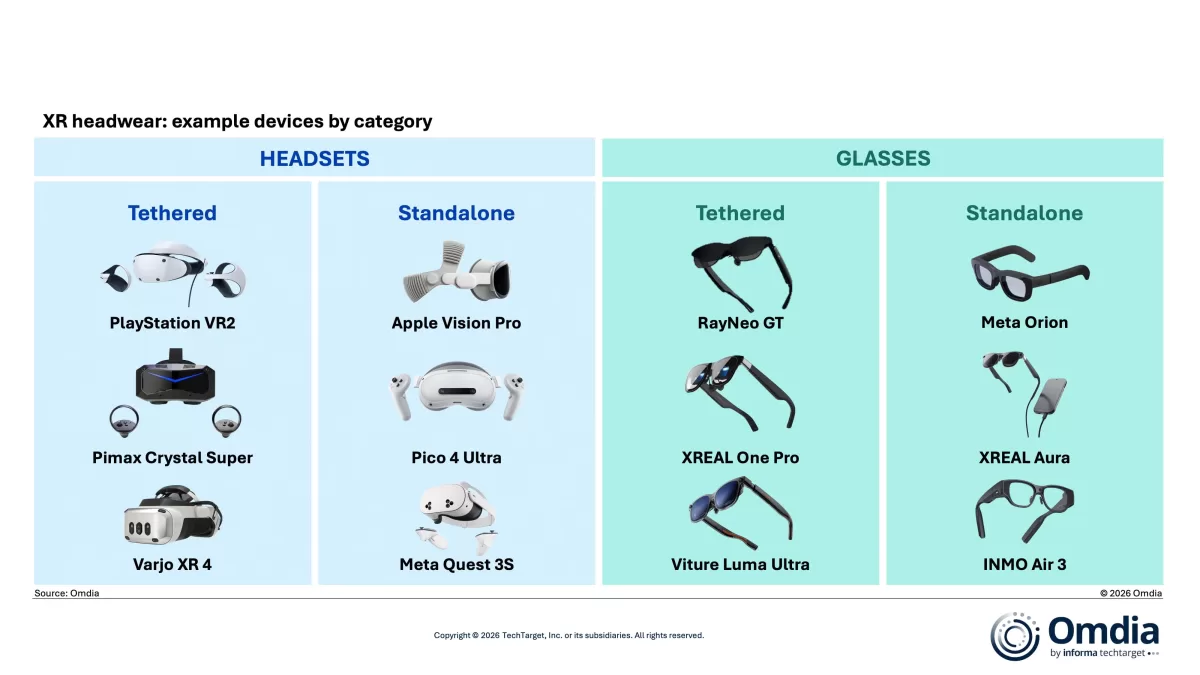
Headsets continue to struggle. Shipments of standalone XR headsets—devices such as Meta’s Quest 3 and Apple’s Vision Pro—are forecast to decline 15 per cent to 4.7 million units in 2026, with contractions extending into 2027, marking a fifth straight year of declines since the pandemic-era peak in 2021/22.
A modest rebound is predicted in 2028 to 5.0 million units, contingent on Apple introducing a more accessible Vision Pro that could spur stronger competition from Samsung, Vivo, and others. Tethered headsets are set to fall even faster, down 34 per cent in 2026 to 500,000 units as standalone alternatives displace them.
“Despite maturing technology, bulky XR headsets struggle to demonstrate everyday utility for mainstream consumers,” said Qiran Ju, Senior Analyst at Omdia.
“Meta has prioritised AI glasses, while Google signaled a similar direction at I/O 2026 with emphasis on XR glasses. Lighter form factors are better positioned to gain widespread consumer acceptance and steer the future of XR development.”
The findings position XR glasses—particularly tethered models—as the key growth engine in an intelligent headwear market that also includes AI glasses. As consumer comfort with face‑worn devices rises, Omdia argues, the momentum is shifting decisively toward slimmer designs, even as traditional headsets face prolonged pressure.
You must be logged in to post a comment.