

- Middle East traffic remains anchored to legacy bands: 5 GHz carried 55.4% of samples in first quarter of 2026, with 2.4 GHz still accounting for 44.2% and 6 GHz with just 0.3%.
- Omdia forecasts Wi‑Fi 7 customer‑premises equipment to expand at a 35.2% annually, reaching 13.8% of the global consumer installed base by 2030, while Wi‑Fi 6 remains dominant at 62% (9.7% growth). Wi‑Fi 8 (802.11bn) is expected to debut from 2028, with a focus on reliability, roaming, latency, and power efficiency rather than headline speeds.
The Middle East’s shift to next‑generation Wi‑Fi remains nascent, with just 0.3 per cent of Wi‑Fi samples using the 6 GHz band in the first quarter of 2026, up slightly from 0.2 per cent a year earlier, according to Ookla Speedtest data.
Uptake is concentrated in Gulf Cooperation Council (GCC) economies, led by the United Arab Emirates (1.1 per cent) and Qatar (0.9 per cent), while much of the region continues to rely on older spectrum.
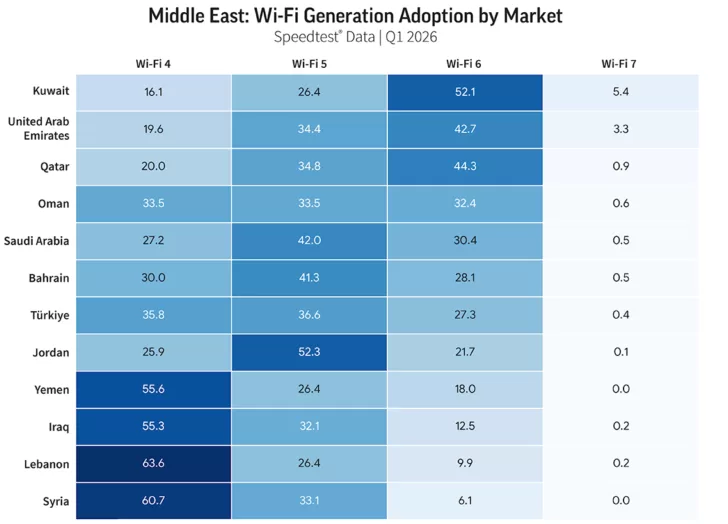
Despite policy moves in advanced markets such as Saudi Arabia to open the full 1,200 MHz of 6 GHz for unlicensed use, Middle East traffic remains anchored to legacy bands: 5 GHz carried 55.4 per cent of samples in FIRST QUARTER OF 2026, with 2.4 GHz still accounting for 44.2 per cent.
Analysts say regulatory and economic fragmentation is dampening regional averages and masking a stark divide between fibre‑dense GCC markets—now matching or outpacing Europe—and non‑GCC Levant and North African markets, which remain tied to legacy infrastructure.
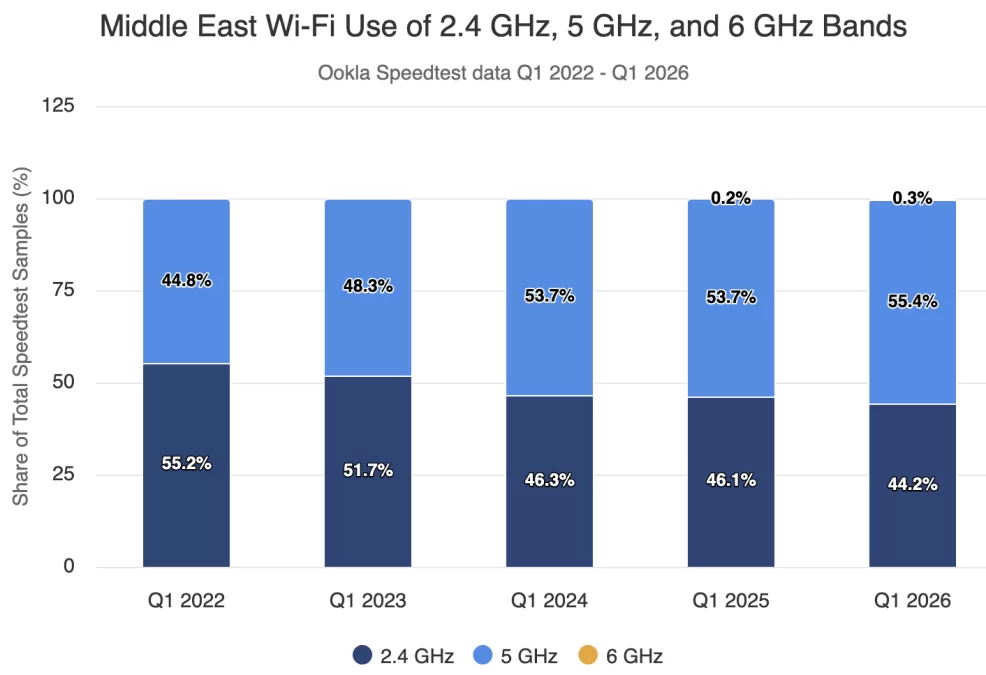
Technology mix data underscores that split. Wi‑Fi 4 remains the single largest standard in the region at 38.8 per cent of samples, followed by Wi‑Fi 5 at 34.9 per cent. While Wi‑Fi 4 is declining and Wi‑Fi 7 has entered the market, the transition is uneven and closely linked to spectrum availability and CPE upgrades.
Globally, Wi‑Fi 7 adoption is early but accelerating. After the Wi‑Fi 7 (802.11be) specification was finalised in July 2025, the standard reached 1.8 per cent of samples by first quarter of 2026, alongside Wi‑Fi 6 at 26.7 per cent, Wi‑Fi 5 at 38.3 per cent and Wi‑Fi 4 at 33.2 per cent.
Band usage continues to shift toward 5 GHz, which climbed from 49.4 per cent of samples in first quarter of 2022 to 59.8 per cent in first quarter of 2026, while 2.4 GHz fell from 50.6 per cent to 38.5 per cent. The 6 GHz band remains a small but growing slice of global usage—and within that slice, Wi‑Fi 7 is punching above its weight: about one‑third (33.7 per cent) of 6 GHz samples in first quarter of 2026 came from Wi‑Fi 7 CPE, up from 16.5 per cent a year earlier.
The appeal of 6 GHz and Wi‑Fi 7 is clear. Where fully allocated, 6 GHz enables up to three contiguous 320 MHz channels, drastically boosting capacity while avoiding congestion from legacy devices.

Wi‑Fi 7 further lifts performance with 4096‑QAM and multi‑link operation, which allows devices to use multiple bands simultaneously for faster, more resilient connections. Real‑world gains depend on both routers and devices supporting 6 GHz; older access points can block 6E/7‑capable phones from tapping the band. Higher frequencies also travel shorter distances—challenging coverage but improving interference management in dense settings.
Looking ahead, Omdia forecasts Wi‑Fi 7 customer‑premises equipment to expand at a 35.2 per cent CAGR, reaching 13.8 per cent of the global consumer installed base by 2030, while Wi‑Fi 6 remains dominant at 62.0 per cent (9.7 per cent CAGR). Wi‑Fi 8 (802.11bn) is expected to debut from 2028, with a focus on reliability, roaming, latency, and power efficiency rather than headline speeds.
You must be logged in to post a comment.