

- Private developers dominate the landscape, largely powered by AI companies and startups.
- South Korea, Japan, and India lead the APAC ecosystem, each with distinct structural characteristics.
The Middle East has emerged as the undisputed global leader in Sovereign AI Large Language Models, and at the centre of this transformation stand two nations: the UAE and Saudi Arabia.
According to Counterpoint Research’s landmark 2026 Sovereign AI LLM Index, the region claimed four of the ten leading-edge positions on the sovereignty spectrum — with the UAE’s own Falcon H1 ranking first across every measured dimension and Saudi Arabia’s ALLaM cementing the Kingdom’s place as a sovereign AI powerhouse.
This is not merely a story of model development. It is a deliberate, state-driven recalibration of how nations assert technological independence, protect linguistic heritage, and deliver public services on their own terms.
Developed by the Technology Innovation Institute (TII) in Abu Dhabi, Falcon H1 ranks as the world’s top Sovereign AI LLM, outpacing competitors in every category assessed by Counterpoint Research. TII now holds the distinction of being the UAE’s premier Sovereign AI LLM developer, followed closely by MBZUAI (Mohamed bin Zayed University of Artificial Intelligence).
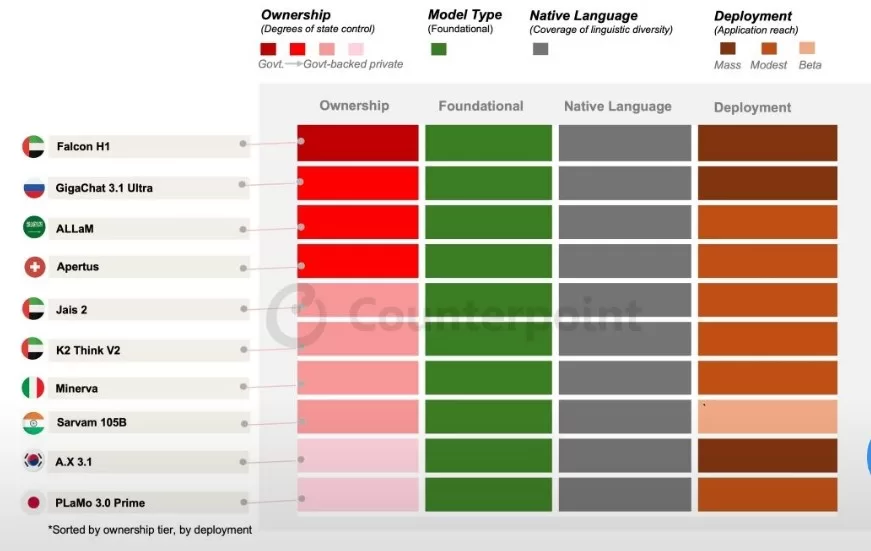
What sets these Middle Eastern models apart is a combination of structural and functional advantages. Their government-affiliated ownership models provide a strong sovereignty foundation, while comprehensive Arabic dialect coverage ensures genuine linguistic representation.
Perhaps most compelling is their real-world deployment footprint — the UAE’s TAMM super app, for instance, already offers Sovereign AI-native services to citizens, demonstrating that these are not merely research projects but operational public infrastructure.
Expanding regional landscape
The Middle East’s Sovereign LLM ecosystem is far from static. Qatar’s Fanar 3.0 is confirmed for launch in December 2026, while Iraq is advancing its own government-led Sovereign LLM initiative. Oman, through its Ministry of Transport, Communications and Information Technology (MTCIT), plans to scale its national LLM Mu’een. Meanwhile, Kuwait, Jordan, and Bahrain are currently in the strategy phase, signaling that the regional momentum is only accelerating.
Iran, by contrast, remains an outlier — its approach relies purely on adapted builds rather than foundational model development, placing it in a fundamentally different category on the sovereignty spectrum.
APAC’s parallel rise
Beyond the Middle East, the Asia-Pacific region has emerged as another Sovereign AI powerhouse. South Korea, Japan, and India lead the APAC ecosystem, each with distinct structural characteristics.
India secured a place at the leading end of the spectrum with Sarvam 105B, and notably ranks higher on the sovereignty dimension due to its Public-Private Partnership (PPP) structure — an ownership model that Counterpoint Research views favorably for national AI independence.
Japan and South Korea, despite possessing richer AI ecosystems, pay what analysts describe as an “ownership penalty.” South Korea accounts for the highest share of foundational LLMs globally at 17 per cent, followed by Japan at 11 per cent, yet both operate largely through government-backed private ownership models rather than direct state affiliation. Japan’s GENIAC-backed developers include Preferred Networks, NTT, SoftBank, and Rakuten, while South Korea’s MSIT-backed ecosystem features LG AI Research, SK Telecom, and Naver.
The sovereignty spectrum
Analyzing the broader landscape, Research Director Marc Einstein explained the methodology behind the rankings: “Positioned by capability and adoption, all 10 LLMs at the leading edge of the sovereignty spectrum are foundational builds, publicly funded or jointly developed by government and private partners, most optimized for deep native language coverage over English benchmarks.”
Einstein further emphasised the strategic pivot underway globally: “The Sovereign AI LLM landscape has fundamentally shifted to national strategic consideration. Countries are prioritizing LLM Sovereignty as nations can introduce data security risks, alongside challenges in linguistic diversity, and tech independence.”
This urgency has been sharpened by recent geopolitical developments. “With the rising political risk in the usage of foreign-developed LLMs, following the recent ban on Claude’s Fable 5, the case for Sovereign models further strengthens,” Einstein noted.
A strategic divide
Counterpoint’s data reveals a telling structural pattern across the global Sovereign AI LLM landscape. Adapted models — those built on pre-existing base models — dominate with a 56 per cent share, outpacing foundational models developed from scratch. This reflects the pragmatic reality that many nations initially leveraged open-source foreign bases to accelerate their AI capabilities.
However, the trend lines point decisively in one direction. Countries are now taking strategic, deliberate steps to reduce reliance on open-source foreign foundations, recognizing that true sovereignty requires control at every layer of the stack. This transition is not merely about technological capability but about long-term data security, linguistic self-determination, and freedom from foreign dependency.
From a developer domain perspective, the Sovereign LLM space is largely powered by AI companies and startups — including Mistral AI, Sakana AI, Cohere, and Sarvam AI — contributing to both foundational and adapted models across their portfolios. This public-private dynamic continues to shape the competitive landscape.
You must be logged in to post a comment.