

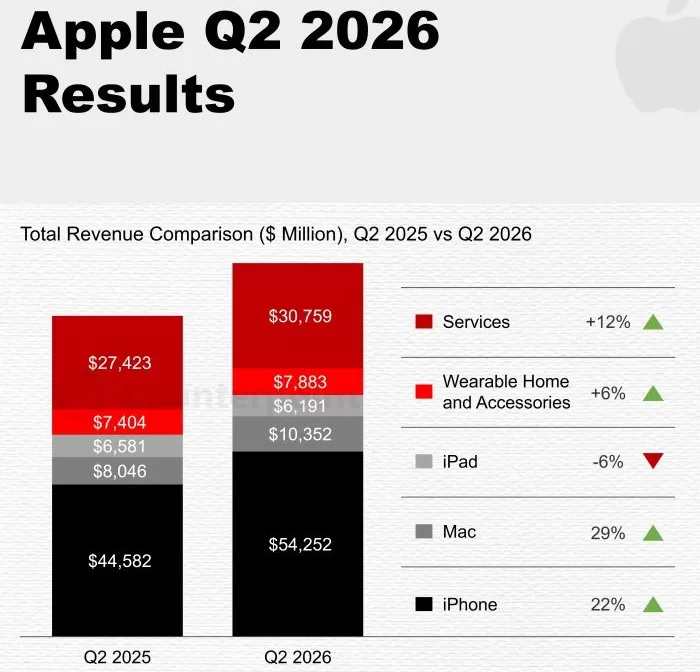
- Apple revenue rises 16.4% to $109.4b while iPhone sales surge 21.7% and Mac sales 28.7%.
Apple delivered a mixed bag for investors, posting fiscal third-quarter results that sailed past Wall Street estimates — only for a weaker-than-expected September-quarter forecast to knock its shares down 5.5 per cent in after-hours trading.
The culprit: worsening supply chain bottlenecks that the company warned would only intensify in the months ahead.
Speaking on the earnings call, Chief Executive Tim Cook didn’t mince words. “We’re seeing some very significant supply constraints currently with limited flexibility in the supply chain to remedy it,” he said, adding that Apple was “evaluating all options” for alternative memory-chip suppliers.
Chief Financial Officer Kevan Parekh laid out the numbers: Apple expects revenue growth of 9 per cent to 11 per cent for the September quarter compared with a year earlier.
The iPhone revenue, the company’s crown jewel, is projected to grow at a mid-teens clip — respectable, but shy of the 17.6 per cent analysts had targeted. Gross margins were guided to a range of 47 per cent to 48 per cent.
The supply pinch centres on advanced semiconductor nodes, with limited availability threatening to restrain shipments across iPhone, Mac, and iPad lines in the coming quarter.
“Since memory prices are expected to continue their upward trend, we expect a tougher environment for the smartphone industry in the second half. Rising component costs are forcing price increases across the Android ecosystem,” Tarun Pathak, Research Director at Counterpoint Research, said.
However, he said that Apple is expected to outperform the industry across its key hardware categories driven by the strength of its installed base and initial positive reception of Siri AI.
“OEMs face a difficult choice between protecting margins and protecting volumes, and the market will feel that pressure. Apple has so far avoided that trade-off.”
A record despite headwinds
For the fiscal third quarter ended June 27, Apple posted revenue of $109.42 billion — a 16.4 per cent jump from the prior year. Profits came in at $2.02 per share, with 11 cents attributable to one-time tariff refunds from the US government.
Strip those out, and Apple still delivered earnings comfortably above the $1.89 per share analysts expected.
iPhone: Best-ever Q3
Driving results was a 21.7 per cent surge in iPhone sales to $54.25 billion. That marked Apple’s best-ever iPhone performance for a third quarter — a period when phone sales typically ease as consumers hold out for September’s new models.
“iPhone’s growth was driven by the strong performance of its 17 series. Apple held iPhone prices throughout the quarter, while competitors’ prices rose by 15%-20%. This worked to Apple’s advantage. Apple was also aggressive with its shipments, especially in China, positioning for market share gains as competitors raised prices. Anticipation of iPhone price increases in the future also pulled forward some demand,” Varun Mishra, Principal Analyst at Counterpoint Research, said.
This year proved different. A global memory-chip crunch that prompted Apple to raise prices on Macs and iPads sent customers flocking to the iPhone, which has so far been spared a price hike. Wall Street analysts increasingly expect that to change around the September launch event, especially with component costs continuing to climb.
Mac and iPad: Divergent paths
Mac sales were a standout, vaulting 28.7 per cent to $10.35 billion and easily clearing estimates of $8.74 billion. The entry-level MacBook Neo and high-end MacBook Pro both performed strongly despite carrying higher price tags — a testament to resilient demand in Apple’s professional and education segments.
iPad sales, however, painted a different picture, slipping 5.9 per cent to $6.19 billion and missing the $6.92 billion that analysts had forecast. Cook attributed the softness to a “tough compare” against the prior year, when the launch of the budget A16 iPad juiced the segment’s numbers.
Apple’s services division — its second-largest revenue engine — grew 12.1 per cent to $30.74 billion but fell short of the $31.22 billion consensus. Coming alongside the supply-driven forecast cut, the miss was enough to unsettle some investors who had grown accustomed to services reliably over-delivering.
Gross margins landed at 50.1 per cent, with tariff refunds contributing roughly two percentage points. On a normalised basis, margins stood at 48.1 per cent, near the midpoint of Apple’s guidance and above analyst expectations of 47.92 per cent — a solid result given the memory-cost headwinds the company had flagged earlier.
Market context
Apple’s stock has climbed more than 22 per cent this year, and the company recently reclaimed the title of world’s most valuable company from AI chip leader Nvidia. That rally has raised the bar for execution, and Thursday’s forecast cut — framed squarely as a supply problem, not a demand one — tested investor patience.
The coming quarter will hinge on whether Apple can navigate what Cook described as worsening component shortages, particularly in memory and advanced semiconductors, while simultaneously managing what could be a pivotal iPhone launch cycle in September. If memory costs continue to bite and supply remains tight, the question of whether Apple will finally pass those costs on to iPhone buyers will loom larger than ever.
You must be logged in to post a comment.