Home Blog Page 165

Nokia to upgrade 5G enterprise solutions for Ooredoo

  • Ooredoo’s business customers will benefit from high-performance, low-latency 5G connectivity, enhanced IoT capabilities and ultra-reliable communication networks.

Qatar-based telecom operator Ooredoo Group has signed an agreement with Nokia to upgrade business connectivity with 5G solutions.

Under the agreement, both companies will collaborate closely to develop and deploy 5G private networks, delivering innovative market and enterprise-specific solutions customised to meet the diverse needs of businesses across industries.

Ooredoo’s business customers will benefit from high-performance, low-latency 5G connectivity, enhanced IoT capabilities and ultra-reliable communication networks.

 “This partnership marks the beginning of a collaborative effort to build capabilities and develop a pipeline for future opportunities in the 5G enterprise domain,” Najib Khan, Group Chief Business Services Officer at Ooredoo, said.

 Stephan Litjens, Vice President of Enterprise Campus Edge Solutions, Nokia, said the collaboration will help organisations within these emerging markets to supercharge their digital transformation journey and continue to grow and innovate.

FCC flexes its censorship powers, to the detriment of individual freedoms

  • If the FCC can ban Chinese telecoms, it logically follows that they can ban any other service provider. And if so, where do you draw the line?
  • In a world where censorship is a real possibility, how do we know that incumbent telecom providers won’t get preferential terms over smaller challengers?
  • How do we know that their monopoly is not being perpetuated by the very agencies that are meant to pursue the better interests of consumers?
  • Blockchain technology can provide solutions and alternatives as it offers enhanced security features that are designed to withstand modern and sophisticated cyberattacks, Chirp founder says

The Federal Communications Commission (FCC) said it is ordering the US units of China Telecom, China Unicom and China Mobile to discontinue fixed or mobile broadband internet operations in the US shows the agency is flexing its censorship powers, to the detriment of individual freedoms.

This is not the first time the agency is breathing down the neck of Chinese firms. Huawei was banned  as part of an executive order from then-president Donald Trump on May 15, 2019.

At the start of 2019, Huawei was expected to become the world’s largest smartphone manufacturer by the end of that year, stealing the crown from Samsung, but was dealt with numerous accusations over the years of shady business practices despite with no hard proof.

National security concerns

In November 2022, FCC banned equipment authorisations for Chinese telecommunications and video surveillance equipment deemed to pose a threat to national security and the covered List (which lists both equipment and services) included communications equipment produced by Huawei Technologies, ZTE Corporation, Hytera Communications, Hangzhou Hikvision Digital Technology, and Dahua Technology (and their subsidiaries and affiliates). 

Now, the FCC said that China Telecom and the other carriers will have 60 days to discontinue broadband services.  The order also applies to Chinese telecom Pacific Networks and its wholly owned subsidiary ComNet.

The FCC had cited national security concerns in revoking or denying Chinese companies the right to provide US telecommunications services.

The FCC had said Chinese telecom firms were “subject to exploitation, influence and control by the Chinese government.”

Geoffrey Starks, FCC Commissioner, said China Telecom’s website shows that the company operates 26 so-called internet points of presence (POPs) in the US and offers colocation, broadband, IP transit and data centre services.

The FCC cited national security concerns about Chinese access to POPs typically located within data centres.

The new FCC move will again force major internet providers to abide by a set of net neutrality regulations, prohibiting them from blocking or throttling traffic.

Monopolistic behaviour

The rules, which broadly prohibit Comcast, AT&T, Verizon and other providers from favoring some types of internet traffic over others.

Tim Kravchunovsky, founder of decentralised wireless network Chirp, said the FCC’s ban on Chinese telecoms only perpetuates the monopolistic behaviour of telecom giants, and points to blockchain technology as an alternative solution.

 “The Federal Communications Commission’s (FCC) recent decision to ban major Chinese telecoms from offering their services in the US may seem prudent on the surface, but it masks the extent of the agency’s censorship powers, which should make us all very concerned.”

If the FCC can ban Chinese telecoms, he said it logically follows that they can ban any other service provider. And if so, where do you draw the line?

“In a world where censorship is a real possibility, how do we know that incumbent telecom providers won’t get preferential terms over smaller challengers? How do we know that their monopoly is not being perpetuated by the very agencies that are meant to pursue the better interests of consumers?

“In our modern, interconnected world, outright bans on any service provider are not the answer. It would be far better to invest this time and energy into developing more stringent security and monitoring frameworks to keep both users and the government safe, as well as potential cooperation agreements between international carriers.”

Alternative solution

An industry expert said that business users and internet service providers might see an impact.

Kravchunovsky said that blockchain technology can provide solutions and alternatives as it offers enhanced security features that are designed to withstand modern, sophisticated cyberattacks.

However, he said that it can open up possibilities for global wireless telecommunications that are resistant to censorship, which is a threat to individual rights.

“Perhaps, a far greater one than the national security threat presented by Chinese telecoms,” he added.


Hyundai and Kia collaborate with Baidu for connected cars

  • China is expected to achieve 100% connectivity penetration by 2028.

Hyundai Motor and Kia Corp said they have signed a memorandum of understanding (MoU) with China’s Baidu Inc to develop technologies for connected cars.

The two South Korean carmakers and will join hands in a wide array of areas, including connectivity and self-driving technologies, with Baidu and will also utilise Baidu’s smart cloud computing technology to address Beijing’s enhancing data regulations.

“Through the strategic collaboration with Baidu, we will make efforts to establish the ecosystem for connected cars in the Chinese market,” Hyundai and Kia said in a press release.

The agreement came amid the growing market for connected cars in China.

The annual sales of connected cars in China are anticipated to reach 17 million units this year, marking a sharp rise from 7.2 million units tallied in 2019, Hyundai said, citing Chinese data.

According to Counterpoint Research, China is expected to achieve 100 per cent connectivity penetration by 2028. This development positions China to lead the global connected car sales market by 2030, with US, India, Japan, and Germany following suit.

These top five countries are projected to collectively account for over two-thirds of global connected car sales by 2030.

 “China is poised to dominate the connected car market, fueled by the rapid adoption of EVs, C-V2X and other connected infotainment features. Domestic EV manufacturers such as BYD, NIO, Xpeng and Li Auto are striving to differentiate their offerings from traditional players and expand into international markets,” Soumen Mandal, Senior Analyst at Counterpoint Research, said.

Hyundai and Kia have been working closely with Baidu since 2014, including the development of voice recognition technology.

On April 25th, Euisun Chung, Hyundai Motor Group’s executive chair, said that Hyundai will make India as its key export hub and roll out first ‘Made in India’ electric car from its Chennai plant in 2025.

Healthify cuts 27% of its staff in restructuring move

  • Impacted employees to get two-month’s salary as severance pay, extended insurance coverage, accelerated stock vesting period in some cases, and leave cash encashment.

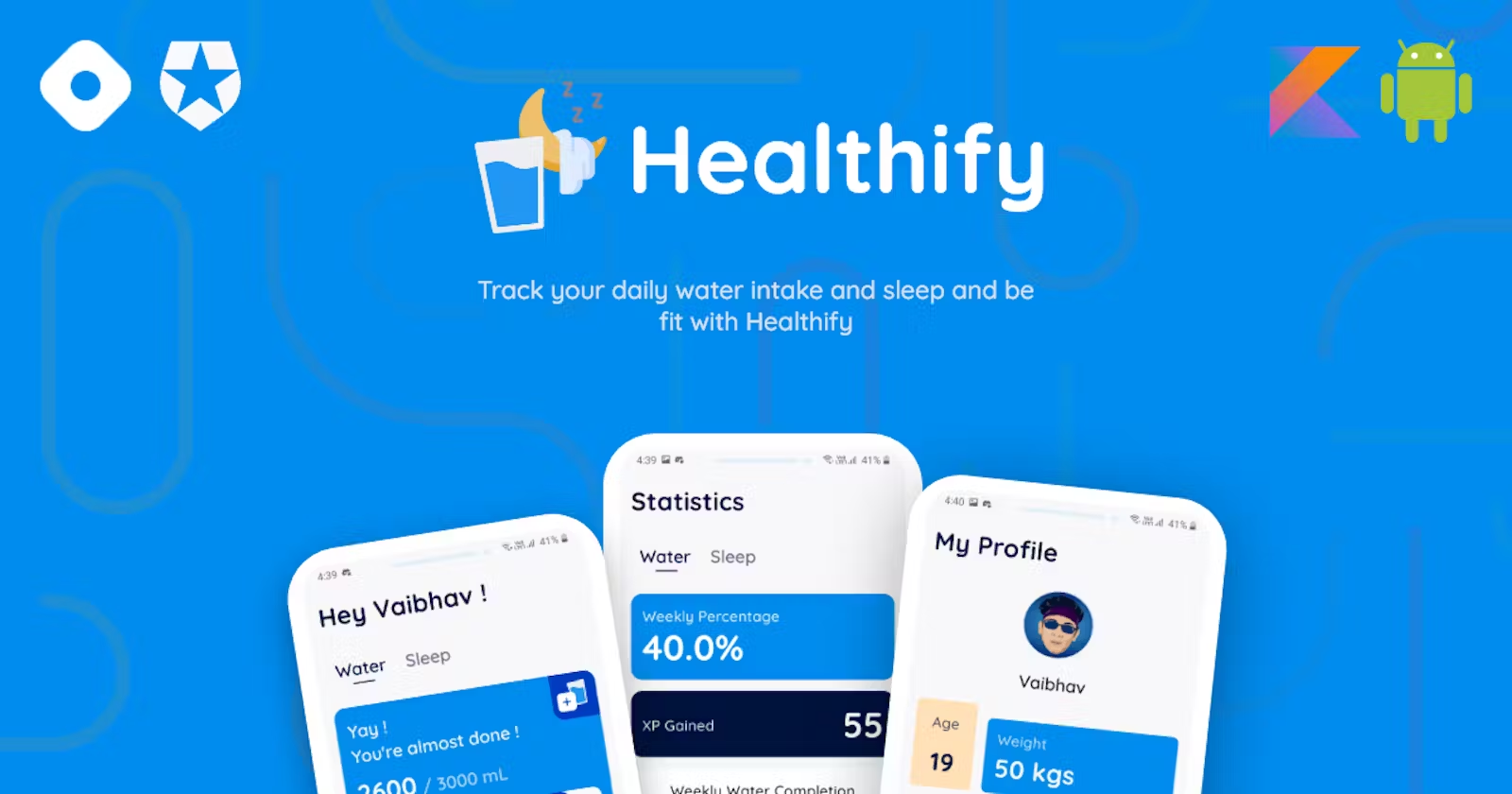
Bengaluru-based healthtech startup Healthify has slashed around 150 employees, or about 27 per cent of its workforce, in a restructuring exercise earlier this week, Inc42 reported.

The layoffs mostly impacted employees from sales and product teams.

Founded in 2012, Healthify’s health and fitness app uses artificial intelligence (AI) to track diet, fitness and weight, and to offer coaching services.

Healthify cofounder and CEO Tushar Vashist, confirming the layoffs, said the restructuring exercise was undertaken as the startup is looking to make its India business EBITDA profitable and expand its offerings in the US market.

Global expansion

“In the next three-four months, our India business will turn EBITDA profitable and this restructuring was an unfortunate but an important step in line with achieving this. We also have to make sure we have enough resource allocation for the global expansion,” Vashisht said. 

 “We deeply understand the impact of these changes on our affected employees and will provide them robust support during this transition, including comprehensive severance packages, extended insurance coverage, and job placement assistance,” Healthify said.

The impacted employees have been offered two-month’s salary as severance pay, extended insurance coverage, accelerated stock vesting period in some cases, and leave cash encashment, it said. 

In 2021, the startup cut around 150 jobs across teams including SME (subject matter expert), quality analytics, product and marketing.

India to witness fastest growth in connected car sales by 2030

  • About nine out of 10 connected cars sold in 2030 will have embedded 5G connectivity.
  • Global connected car sales are likely to exceed 500m in the 2024-2030 period.

India is set to experience the fastest growth in connected car sales between 2023 and 2030 as domestic automakers are gradually catching up with their international counterparts and enhancing their digital offerings to improve the driving experience, a research analyst said.

However, Soumen Mandal, Senior Analyst at Counterpoint Research, said, that China to lead the global connected car sales market by 2030, with US, India, Japan, and Germany following suit.

These top five countries are projected to collectively account for over two-thirds of global connected car sales by 2030 and about nine out of 10 such vehicles sold in 2030 will have embedded 5G capability.

As per Counterpoint Research stats, global connected car sales are likely to exceed 500 million in the 2024-2030 period.

At present, Mandal said that Germany leads in terms of connectivity penetration but China is expected to achieve 100 per cent connectivity penetration by 2028.

Advanced mobility use cases

 “China is poised to dominate the connected car market, fuelled by the rapid adoption of EVs, C-V2X and other connected infotainment features. Domestic EV manufacturers such as BYD, NIO, Xpeng and Li Auto are striving to differentiate their offerings from traditional players and expand into international markets,” Mandal said.

Over the last decade, 4G was the major cellular connectivity embedded in cars. However, the use cases for the cars rolling out over the next decade will warrant 5G connectivity to satisfy the new advanced mobility use cases.

Senior analyst Parv Sharma said that currently, more than 96 per cent of connected cars are powered by 4G while 5G is still picking up.

“The higher price of 5G telematics devices, lack of 5G infrastructure and unavailability of killer use cases have been the major reasons for 5G’s slow growth earlier in the decade. We forecast that by 2030, almost 90 per cent of cars sold will have 5G,” Sharma said.

HealthGenie exposes patients’ sensitive data for several months

India-based healthcare IT solutions provider HealthGenie has allegedly exposed 4.5 lakh sensitive documents of patients that include clinical data and personal data like phone numbers, addresses and payment details, a report said.

The Cybernews research team discovered that the provider left an open Amazon S3 bucket, exposing over 36 gigabytes of data, or nearly 450,000 documents.

The documents allegedly exposed patient details including name, date of birth, phone number, address, medical contract numbers, and payment details.

Out of 450,000 exposed documents, 200,000 were those of the service’s patients. Worryingly, the dataset has been exposed for several months after researchers discovered the open instance and informed the company about the issue.           

“Exposing personal medical data poses severe risks for affected individuals as attackers could use the information for identity theft, financial fraud, targeted phishing attacks, blackmail, and potentially compromise patients’ medical histories and personal information. Individual healthcare data can be sold on dark web forums,” Cybernews said.

The research team also contacted HealthGenie for an official comment “but received no response before publishing”.

The Health Genie app with over 100,000 downloads on the Google Play store, offers services such as finding doctors, booking appointments, Electronic Health Record systems, reporting and analytics, and financial monitoring, among others.