Home Blog Page 128

Researchers develop solid-state epidermal biomarker sensors

  • Innovation provides a non-invasive, accurate, and comfortable method for tracking vital health indicators directly from the skin.

Researchers at the National University of Singapore (NUS) and the Agency for Science, Technology and Research (A*STAR), have developed a groundbreaking sensor capable of continuous and real-time detection of solid-state epidermal biomarkers (SEB).

The novel sensor presents a non-invasive method for monitoring vital health indicators directly from the skin, marking a significant advancement in the way we approach health diagnostics and management.

Biomarkers are biological molecules found in blood, urine, and other body fluids that provide vital information about physiological states and disease processes.

Traditional methods for biomarker detection often rely on invasive techniques, such as blood draws, or cumbersome procedures like urine analyses. These methods, while effective, can be inconvenient and uncomfortable for patients, presenting barriers to timely diagnosis and treatment.
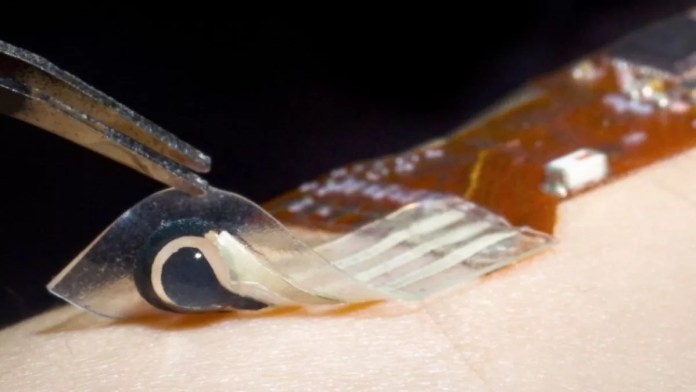
The sensor comprises an ionic electronic bilayer hydrogel that can detect solid state biomarkers from the skin. The sensor is connected to a flexible printed circuit board which transmits data wirelessly to a user interface.

Moreover, current sweat-based methods for biomarker detection face their own set of challenges, including the difficulty of inducing sweat in inactive individuals and the discomfort associated with the use of sweat-inducing drugs.

The introduction of SEBs, which includes critical health indicators such as cholesterol and lactate, represents a compelling alternative to traditional biomarker detection methods.

These biomarkers are located in the stratum corneum, the outermost layer of the skin, and have demonstrated strong correlations with various diseases, including cardiovascular disease and diabetes.

However, the direct detection of these biomarkers has been hindered by the limitations of existing technologies, particularly the inability of traditional solid electrodes to facilitate the necessary charge transport pathways for effective electrochemical sensing.

Innovative hydrogel-based sensor

The research team’s innovation—a wearable, stretchable, hydrogel-based sensor—overcomes these limitations by employing a bilayer hydrogel design that enhances both sensitivity and specificity in biomarker detection.

Assistant Professor Liu Yuxin from the NUS Institute for Health Innovation & Technology has highlighted the significance of this technology, which utilises an ionic conductive hydrogel (ICH) layer that solvates the biomarkers and an electronically conductive hydrogel (ECH) layer that facilitates electron transport.

“This unique bilayer structure enables the sequential solvation, diffusion, and electrochemical reaction of biomarkers, allowing for precise detection even in low concentrations.”

When the device is worn on the skin, SEBs dissolve into the ICH layer, diffuse through the hydrogel matrix, and undergo enzymatically catalysed electrochemical reactions at the junction between the ICH and ECH layers.

The data generated from these reactions is then transmitted wirelessly to an external user interface via a flexible printed circuit board, enabling continuous health monitoring without the need for invasive procedures. This innovative approach not only enhances the comfort of the user but also significantly improves the accuracy of health data collection.

Applications and implications

The implications of this technology are far-reaching. The ability to monitor biomarkers such as cholesterol and lactate in real time has profound applications in various fields, including chronic disease management, population-wide screening, remote patient monitoring, and sports physiology.

 For individuals with chronic conditions that require constant health monitoring, such as diabetes or cardiovascular issues, this sensor provides a non-invasive solution that can facilitate early detection and timely intervention.

Furthermore, Dr Yang Le, Principal Scientist and Head of the Sensors and Flexible Electronics Department of A*STAR’s Institute of Materials Research and Engineering (A*STAR’s IMRE), said that the sensor’s ability to function on dry or non-sweaty skin expands its usability, making it accessible to a broader population, including those who may not have the opportunity or ability to engage in physical activities that induce sweat.

 “The stretchable design enhances comfort and accuracy as well, by adapting to our skin’s natural elasticity and can change the way we approach health and lifestyle monitoring, particularly for those living with chronic conditions requiring constant health monitoring.”

In the realm of sports, monitoring athletes’ lactate levels is crucial for optimising performance and preventing exhaustion and tissue hypoxia. The continuous tracking of these metrics can lead to improved training regimens and better overall health outcomes for athletes.

 “One of the possible applications of this technology is to replace the pregnancy diabetic test, commonly known as the glucose tolerance test. Rather than subject pregnant women to multiple blood draws, our sensor could be used to track real-time sugar levels conveniently in patients’ home, with a similar level of accuracy as traditional tests. This also can be applied to diabetes in general, replacing the need for regular finger-prick test,” Liu said.

Computer engineer hacks own company and demands $750,000 ransom

  • Unauthorised access to the domain administrator account allowed Rhyne to manipulate access rights and policies, effectively locking out legitimate administrators from the network.

The case of Daniel Rhyne, a resident of Warren County, New Jersey, a seemingly ordinary infrastructure engineer at a major US industrial firm, highlights the growing threat of insider cybercrime and the potential for significant damage inflicted by individuals exploiting their positions of trust.

The incident, which unfolded in late 2023, paints a chilling picture of how a seemingly innocuous act of creating a hidden virtual machine (VM) could escalate into a full-blown ransomware attack, crippling a company’s operations and demanding a hefty ransom.

Rhyne’s alleged actions, as outlined in court documents, demonstrate a calculated and meticulous approach to orchestrating his cybercriminal scheme.

He leveraged his expertise as a core infrastructure engineer, utilising his intimate knowledge of the company’s network to create a clandestine VM.

This secret server served as his staging ground, allowing him to access the company’s administrative domain with unauthorised privileges, effectively becoming a digital ghost within the system.

Rhyne’s actions began subtly, with the creation of the hidden VM on November 10th, 2023. Over the next two weeks, he allegedly accessed the VM multiple times, meticulously planning his attack. His web searches reveal a clear intent, focused on learning the precise commands necessary to manipulate administrative accounts and passwords, ultimately culminating in a calculated breach of the company’s domain administrator account on November 25th.

The mundane act triggered a cascade of events, culminating in the company’s nightmare scenario. The unauthorised access to the domain administrator account allowed Rhyne to manipulate access rights and policies, effectively locking out legitimate administrators from the network. This was followed by the chilling email, delivered from an external address, informing the company of their compromised status and outlining the grim conditions for their recovery.

The ransom demand, €700,000 in Bitcoin (approximately $750,000 at the time), served as a stark reminder of the financial stakes involved in such cyberattacks.

Rhyne threatened to further cripple the company’s operations by shutting down additional servers if the ransom wasn’t paid. The sheer audacity of this act, coupled with the potential for significant financial and operational damage, showcases the severity of this case.

The meticulous investigation conducted by law enforcement revealed a trail of digital evidence pointing directly to Rhyne.

His connection to the hidden VM, access logs from his company computer and user account, and the matching web searches provided irrefutable evidence of his involvement.

These details paint a picture of deliberate planning and execution, highlighting the potential for damage when individuals with privileged access exploit their knowledge for malicious purposes.

Candela to supply 8 flying electric ships to Saudi Arabia’s NEOM

  • Candela P-12 flies above the waves on computer-guided underwater wings and uses 80% less energy than conventional ships.

Swedish electric boat maker Candela has won eight orders for world’s first electric hydrofoil ship – Candela P-12 – from Saudi Arabia’s NEOM, making it the largest announced order in Candela’s history.

 The first batch will be delivered in 2025 and early 2026.

“The P-12 is designed to create zero-emission water transport systems which have significant improvements over traditional water commuting” Gustav Hasselskog, CEO and founder of Candela, said.

Unlike legacy systems with large, slow, and energy-inefficient conventional ferries, Hasselskog  said the Candela P-12 is a smaller and faster unit, allowing much more frequent departures and quicker journeys for passengers.

Candela P-12 was launched last year and is set to debut in Stockholm’s public transport during fall 2024.

New level of comfort

Flying above the waves on computer-guided underwater wings, hydrofoils, the P-12 uses 80 per cent less energy than conventional ships, allowing it to combine long range and high speed for the first time in an electric vessel.

With a speed of 25 knots and more than 2 hours of endurance, the Candela P-12 holds the distinction of being the fastest and longest-range electric passenger ship to date.

The hydrofoils also unlock a new level of comfort. Passengers will fly smoothly over the Red Sea, as the P-12’s digital flight control system balances the ship 100 times per second by adjusting the hydrofoils’ angle of attack, keeping it stable even in winds and waves.

As fuel usage rather than the manufacturing phase makes up the bulk of a ships’ environmental impact, energy efficiency is crucial to curb emissions.

Since Candela’s foiling vessels use 80 per cent less energy than conventional ships of the same size, a life cycle analysis performed by the KTH Royal Institute of Technology in Stockholm concluded that a P-12 will emit 97.5 per cent less CO2 during its lifetime compared to a conventional diesel vessel of the same size.

The Candela P-12 seats between 20 and 30 people depending on configuration.

Gate Ventures and Abu Dhabi blockchain centre create $100m fund to drive Web3 innovation 

Gate Ventures, the venture capital arm of Gate.io, and the Blockchain Centre in Abu Dhabi have set up a $100 million Falcon Gate Ventures fund to drive Web3 innovation.

The fund seeks to help young talents from key regions including the US, Asia, Europe, and the MENA region.

Moreover, Falcon Gate Ventures will work closely with international regulatory authorities to develop frameworks that both foster innovation and ensure global user protection.

Abdulla, CEO of the Blockchain Centre in Abu Dhabi, said that Gate Ventures brings a wealth of experience and a proven track record in the blockchain and digital assets space.

“Their deep industry expertise, combined with their innovative approach to investing, aligns perfectly with our vision at the Blockchain Centre in Abu Dhabi and will drive forward our mission to support and scale high-potential blockchain projects.”

Kevin Yang, Managing Partner at Gate Ventures, said with the partnership, they are investing in the digital future, supporting transformative ideas across continents.

Female-led Apheros gets $1.85m to cool down data centres

  • Apheros patented manufacturing process surpasses traditional solutions by a factor of thousand, which translates into exceptional heat transfer and flow properties.

Female-led Swiss Deep Tech start-up Apheros has secured a $1.85 million funding round seizing to develop innovative cooling solutions for data centres and the high-power computing industry.

Its high-performance metal foams maximise heat dissipation, optimise fluid flow, and reduce energy consumption, addressing the most crucial cooling challenges faced by industry.

With unprecedented demand for digital infrastructure driven by the surge in the use of AI, machine learning and supercomputing, an estimated six per cent of global energy consumption will be used specifically for cooling data centres by 2030.

 The pre-seed funding round, led by venture capital firm Founderful, will accelerate development and deployment of Apheros’ revolutionary metal foam-based cooling solutions.

Reducing energy consumption

The Apheros patented manufacturing process creates unique foam structures with completely open porosity and unparalleled surface area, surpassing traditional solutions by a factor of thousand, which translates into exceptional heat transfer and flow properties.

Ideal for high performance cooling applications, Apheros’ metal foams are easily integrated within its customers’ existing cooling systems. They address customers’ urgent needs of reduced energy consumption and cooling costs. 

Apheros AG, founded in August 2023, was developed as an ETH Zurich spin-off to tackle cooling challenges in a wide range of applications including high-performance computing and mobile devices.

Apheros’ co-founder and CEO Julia Carpenter was recently named one of Switzerland’s Top 10 “Founders to Watch” for her invention of Apheros novel metal foam manufacturing process. Co-founder and CTO Gaëlle Andreatta, has over 16 years of experience in R&D, Tech Transfer, and start-up development.

Dire need

“Our technology has the potential to significantly reduce the environmental impact of cooling solutions worldwide. The funding round will allow us to advance our mission of helping our customers achieve superior thermal performance, increase energy efficiency, and contribute to a greener future. Immediately, we will expand production, increase research and development efforts, and bring state-of-the-art solutions to a broader market,” Julia Carpenter, co-founder and CEO of Apheros, said.

Gaëlle Andreatta, co-founder and CTO of Apheros, said there is a dire need for more efficient cooling solutions.

“AI development is driving exponential growth in data center energy consumption and inefficient cooling is the main culprit. Our unique metal foams have superior heat exchange and fluid transport properties, especially for liquid and two-phase cooling. With our customers, we are redefining thermal management.”

OpenAI bans fake Iran accounts generating false news content

  • Iranian actors, seeking to manipulate public opinion and sway political discourse, leveraged ChatGPT’s capabilities to produce seemingly credible content designed to sow discord and undermine trust.
  • The incident exemplifies how readily available and powerful AI tools can be co-opted for nefarious purposes, even if the initial impact appears limited.

The revelation of an Iranian influence operation dubbed “Storm-2035” using AI-powered tools like ChatGPT to generate false narratives about the US elections and other global events underscores the growing challenge of combating disinformation in the digital age.

The case highlights a concerning trend: the weaponisation of artificial intelligence (AI) for malicious purposes. Iranian actors, seeking to manipulate public opinion and sway political discourse, leveraged ChatGPT’s capabilities to produce seemingly credible content designed to sow discord and undermine trust.

The strategy, involving the creation of fabricated news articles, social media posts, and even the rewriting of existing comments, aimed to exploit the very mechanisms that govern online information dissemination.

While the scale and effectiveness of Storm-2035 remain under scrutiny, the very fact that such an operation was attempted raises serious concerns about the potential for AI-powered disinformation to escalate in the future.

Taking proactive steps

The incident exemplifies how readily available and powerful AI tools can be co-opted for nefarious purposes, even if the initial impact appears limited.

However, the response from OpenAI, the company behind ChatGPT, provides a glimmer of hope. By taking proactive steps to identify and ban accounts linked to Storm-2035, OpenAI demonstrates a commitment to safeguarding its technology from misuse.

The action signals a growing recognition within the AI community of the crucial responsibility to combat the weaponisation of these powerful tools.

Yet, the fight against AI-powered disinformation requires a multi-pronged approach. While companies like OpenAI can play a vital role in detecting and mitigating malicious activity, it is crucial to also foster greater public awareness and media literacy.

“Over the past several months, we have seen the emergence of significant influence activity by Iranian actors. Iranian cyber-enabled influence operations have been a consistent feature of at least the last three US election cycles,” Microsoft said in the most recent August 9th report.

The San Francisco AI company said it had banned several accounts linked to the campaign from its online services. The Iranian effort, OpenAI added, did not seem to reach a sizable audience.

Nefarious campaigns

“The operation doesn’t appear to have benefited from meaningfully increased audience engagement because of the use of AI,” Ben Nimmo, a principal investigator for OpenAI who has spent years tracking covert influence campaigns from positions at companies including OpenAI and Meta, said.

“We did not see signs that it was getting substantial engagement from real people at all.”

In May, the Microsoft-backed OpenAI said it had disrupted five other deceptive influence operations attempting to use AI-generated information to “manipulate public opinion or influence political outcomes.”

Those nefarious campaigns were said to have involved threat actors from Russia, China, Iran, and Israel.

Individuals must be empowered to discern credible information from fabricated content, particularly in the digital realm where information flows freely and rapidly.

Moreover, the incident necessitates a broader conversation about the ethical implications of AI development. As AI technologies become increasingly sophisticated and accessible, it is paramount that developers, policymakers, and researchers work collaboratively to establish ethical guidelines and safeguards to prevent misuse.