Home Blog Page 185

Saudi Arabia to outpace UAE in colocation data centre facilities

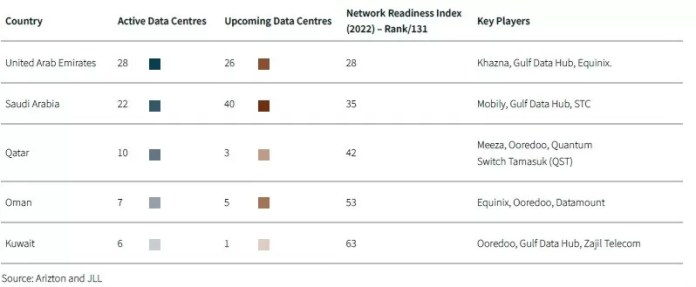
  • Currently, UAE has 28 facilities and Saudi has 22.
  • With approximately 17 facilities, Dubai is a prime market for data centres, followed by Abu Dhabi in the UAE.
  • Key data centre providers in the UAE include Khazna and Equinix apart from hyperscalers and  Mobily and STC in Saudi Arabia.

The UAE and Saudi Arabia have the highest share of data centres in the Middle East and Africa with 28 and 22 colocation facilities respectively, fuelled by digital transformation strategies and smart city initiatives.

Key data centre providers in the UAE include Khazna and Equinix apart from hyperscalers and  Mobily and STC in Saudi Arabia.

However, according to Arizton’s research data, the future supply pipeline in Saudi Arabia is remarkably outpacing the rest of the countries, with around 40 data centres under development while the UAE is expected to have 26 more.
At a time when data has come to define the parameters of innovation, efficiency and competitiveness, not only in real estate but across industries, Faraz Ahmed, Associate, Research at JLL MENA, said that the UAE is boldly leading the charge in the data centre domain in the region.

A visionary approach

“Through strategic investments in smart city infrastructure, a robust AI strategy, and a visionary approach to talent development, the country is not only becoming an investment hub; it is positioning itself for even greater success ahead,” he said.

According to Arizton and JLL, Quantum Switch Tamasuk (QST) has set a goal to develop six new facilities across the kingdom with a power capacity that would reach around 300 megawatts (MW) by 2026.
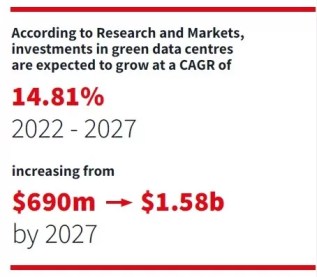
This expansion of data centre capacity is on the back of Vision 2030 and the government’s push to make the country the main Information and Communication Technology (ICT) and data centre hub in the region.

To support its goal, Saudi Arabia has launched an $18 billion strategy to partner with local and international investors and establish a nationwide network of large-scale data centres.

Traditionally, data centre investments in the kingdom have been mainly directed towards the capital city, Riyadh, followed by Jeddah and Dammam.

However, the areas of interest have been expanding and more investments are projected to be pumped into Saudi Arabia’s new smart city, Neom, in the coming years.

This is further supported by the city’s $500 million hyperscale data centre, launched earlier in 2022, which aims to offer fast and reliable data centre services and connectivity to the country and the wider Gulf Cooperation Council (GCC) market.

Khazna to add 12 more

Meanwhile, the UAE has around 26 new data centres that are being developed, which, once operational, will bring the total inventory to 54 data centres.

Dubai is currently the prime market for data centres in the UAE, with around 17 facilities, followed by Abu Dhabi.

Khazna, the leading data centre provider in the UAE, currently operates around 12 data centres across the country and aims to add another 12 over the course of two years, expecting to add a total planned capacity of 300 Megawatts.
Elsewhere in the Middle East, Zenah Al Saraeji, Senior Analyst, Research at JLL MENA, said that other GCC countries are making efforts to attract investments and expand their data centre capacity.

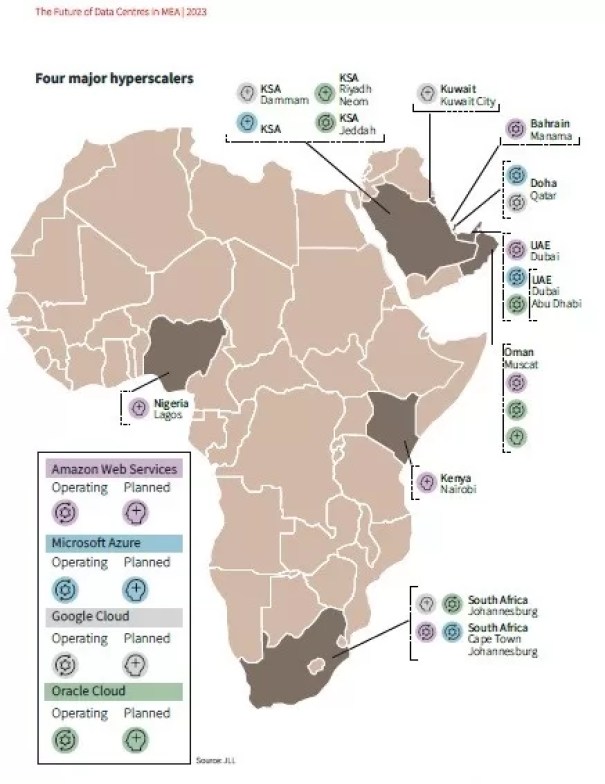
Qatar, for instance, currently has 10 live colocation data centres, with an additional three developments under construction. Furthermore, in May 2023, Google Cloud announced the opening of its Doha cloud region in response to the growing demand for cloud services in Qatar and the Middle East.

Similarly, with six active data centres, Kuwait partnered with Google Cloud earlier this year to open a new cloud region in an effort to support the country’s 2035 vision and achieve its digital transformation strategy. Under the agreement, three sites would be dedicated to opening and operating three mega-space data centres in the country.

5G fuels growth

Moreover, Oman, which has five existing and seven developing data centres, is also considered one of the major regional digital hubs and is focusing on increasing investments in data centres by enhancing its digital infrastructure with 5G networks.

According to a recent report by Research and Markets, the data centre investment market in the Middle East was valued at $4.86 billion in 2022 and is expected to grow at a CAGR of 8.53% from 2023-2028, reaching to $7.94 billion.

“The UAE and Saudi Arabia are expected to be the leading contributors to the growth of data centres, followed by countries like Oman, Kuwait, Bahrain, and Qatar, owing to the rapid deployment of 5G networks,” Al Saraeji said.

QuriousBit gets $2M funding to put India on global map of hit puzzle games

  • QuriousBit  founder aims to build a world class gaming studio based out of India to entertain global audiences.

Bengaluru based gaming startup – QuriousBit  – has secured a $2 million in seed funding to put India on the global map of hit puzzle games.

The funding round was led by Lumikai with General Catalyst joining as co-investors. 

The company aims to utilise the funds from this seed round to create a new benchmark in innovative puzzle games built in India for global audiences.

The founders – Ramakrishna Reddy Y L and Shubham Joshi – will be investing heavily in curating a stellar team to build a high-quality casual mobile gaming studio. 

 “We see a huge opportunity in casual puzzle games beyond match-3 and blast genres. We believe some of these genres are ripe to disrupt with innovative core gameplay mechanics and deeper narratives. Our aim is to build a world class gaming studio based out of India, entertaining global audiences. Lumikai and General Catalyst partnering with us in this journey positions us well to achieve it,” Ramakrishna Reddy Y L, Founder of QuriousBit, said.

Global market value

The global mobile casual games market is worth about $18 billion in 2023, and is expected to grow 1.4 times to $25 billion in 2027.

Over the last few years, the gaming industry has seen the dominance of certain match3 games in the puzzle genre, with limited breakouts beyond match3 and blast themed games.   

“A fresh and innovative approach both in game design and distribution is imperative to achieve category leading success in the highly competitive global casual gaming market given current market conditions. Ram and Shubham’s deep thinking, category expertise, and design orientation deeply impressed us,” Salone Sehgal, Founding General Partner, Lumikai, said.

Deep expertise

The founders have built games that have amassed over 125 million installations and generated combined revenue of over $350 million, including seven titles with positive EBITDA margins.

Prior to establishing QuriousBit, Ram held the position of Assistant General Manager at PlaySimple Games, a global leader in word games, which was acquired by MTG for over $500 million in 2021.

Meanwhile, Shubham served as the Principal Software Engineer at PlaySimple Games. 

“When we met Rama and Shubham, we became fans of their deep expertise, having driven the growth of PlaySimple’s games to over $100 million in revenues, resulting in one of the best exits in the Indian ecosystem to date,” Anand Chandrasekaran, Partner at General Catalyst, said.

Mobile and ICT industry has potential to become a net carbon negative

  • There is growing pressure and expectation from the public that businesses and organisations of all sizes take accountability for their environmental impact.
  • Innovations in recycling and reuse often come about by identifying wasteful or energy-intensive parts of a product’s lifecycle.
  • One of the most challenging aspects is behavioural change.
  • Combating climate change requires belief, motivation and knowledge, and communicating your positive efforts and successes helps to inspire other businesses to take action of their own.

Wildfires at one extreme and devastating flooding at the other. The line between climate concern and climate crisis blurs with each passing headline. 

There is growing pressure and expectation from the public that businesses and organisations of all sizes take accountability for their environmental impact. 

Those businesses that step up earlier will find it easier to change, will be more positively viewed by their employees, consumers, and shareholders, and perhaps could find a competitive advantage by launching more eco-friendly products and services. 

Emissions in the mobile sector 

Much criticism is aimed at the aviation industry – it is responsible for about two per cent of all global emissions. But that is also the figure for the Information and Communications Technology (ICT) sector.

Gerrit Jan Konijnenberg, Special Board Advisor and Initiator of sustainability activities at the MEF.

And as cloud-based services and storage increases, emissions caused by data centres will also increase.

However, the mobile ecosystem can prevent itself from becoming the new villain of the piece by exploiting its unique ability to aid other industries in reducing their emissions through the development of new technologies that result in companies and consumers saving energy, perhaps leading to a reduction in emissions of around 12.1 gigatonnes of CO2 (GtCO2) by 2030. 

So, the mobile and ICT industry has the potential to become a net negative sector. 

What about your business?

Measure the impact of your business

The first step is to measure the carbon footprint of your business. Only when you understand your organisation’s emissions and climate risks will you know where to dedicate your resources?

To understand your carbon emissions, you can use an online calculator for a rough idea. 

Measure the impact of your products

The next step is to complete lifecycle assessments of your different products and services. Identify any carbon-heavy or wasteful aspects, looking at raw materials and energy use in both the production and disposal of old devices.

Innovations in recycling and reuse often come about by identifying wasteful or energy-intensive parts of a product’s lifecycle. A welcome benefit of reducing environmental impact is businesses saving money – for example rather than disposing of its old infrastructure, a data centre may be able to recycle and/or reuse in other areas of its business.

Additionally, telecom consumers should be made more aware of the implications of data waste. Regular file cleanups can reduce emissions and improve efficiency because everything that is stored in the cloud uses energy. It all adds up.

Offset your unavoidable emissions

With a climate plan defined and annual reduction targets identified, you then need to consider offsetting unavoidable emissions.

 It is not reasonable to expect a company to achieve a sudden cut of all emissions. Time is required and there will be some emissions that will always remain. Those emissions can be offset, which means paying for the removal of carbon elsewhere. 

Carbon removal projects are important because even if we were to reduce our emissions to zero, there would still be legacy atmospheric carbon to remove. In other words, stopping making a mess doesn’t absolve us of cleaning up the mess we have already made.

Key challenges and solutions

It might be easy to create a roughly-defined process but it is harder to do it in practice. Rather than gloss over these challenges, it is important to confront them head-on.

One of the most challenging aspects is behavioural change. We all have habits and those habits are hard to break. Breaking them, even knowingly and with considerable effort, can sometimes be uncomfortable. 

But they can often prove to be cost-effective. One business that operated on different floors of a building significantly reduced its energy use (which also saved money) by putting a sign in the building’s lift. 

The sign detailed the energy cost of riding to each floor and asked employees and visitors to consider whether it was necessary to use the lift instead of using the stairs. A five-minute job (printing and affixing the sign) cost very little but had a huge impact on the use of the lift.

Sticking with your plan

Holding your plotted course can sometimes be challenging. It’s easy to feel disheartened by the scale of the challenge. After all, you run an SME – how much will cutting your emissions help? There are, however, vastly more SMEs than big businesses, so don’t underestimate your impact.

To help with this, share good news stories about how environmental projects and sustainability initiatives are working. For example: 

Last year, the EU produced 22 per cent of its electricity from wind and solar power – more than produced from gas; 

Researchers at the University of Cambridge have developed a system that can convert greenhouse gasses and plastic into two sustainable fuels using solar power.

Deforestation in the Amazon has fallen by 61 per cent in January compared to the previous year; Last year, newly installed heat pumps across Europe avoided 8 million tonnes of CO2 emissions.

Communicating your climate action also has benefits. 

Not talking about your efforts is the PR equivalent of leaving money on the table. But beyond this, combating climate change requires belief, motivation, and knowledge, and communicating your positive efforts and successes helps to inspire other businesses to take action of their own.

  • Gerrit Jan Konijnenberg is a Special MEF Board Advisor and Initiator of sustainability activities at the Mobile Ecosystem Forum (MEF). MEF is a global trade body established in 2000 and headquartered in the UK with members across the world. 

UAE awards AED18.7b contract to Yahsat

  • Mandate has also significantly increases the Group’s contracted future revenues to AED25.7 billion, over 16 times its 2022 annual revenues.

The UAE Government has awarded a AED18.7 billion contract to Yahsat to provide satellite capacity and managed services for 17 years.

Under the new mandate Yahsat will provide the Government with secure and reliable satellite capacity and related managed services using the Al Yah 1 and Al Yah 2 satellites, currently in orbit, and supplement this by two new satellites, Al Yah 4  and Al Yah 5  which are expected to be launched in 2027 and 2028, respectively.

 “By complementing our existing fleet with Al Yah 4 and Al Yah 5 next generation satellites, we will be able to serve the government with new solutions that are not currently possible. The performance of the new satellites is expected to significantly surpass current industry capabilities including capacity, coverage and flexibility allowing us to offer a wide range of applications,” Musabbeh Al Kaabi, Chairman of Yahsat, said.

New chapter

The mandate has also significantly increases the Group’s contracted future revenues to AED25.7 billion, over 16 times its 2022 annual revenues, extending backlog well beyond 2040 and providing security and visibility over its future cash flows.

Yahsat signed an Authorisation-to-Proceed with Airbus in June 2023 for the construction of AY4 and AY5.

Ali Al Hashemi, Group Chief Executive Officer at Yahsat, said that this is a new chapter in Yahsat’s momentous journey serving the satellite communications requirements for the UAE Government.

“Representing one of the largest backlog multiples and strongest balance sheets in the industry, we remain optimistic about providing a broader, more diverse and cutting-edge solutions portfolio to both the government and our customers.”

UAE, Bahrain and Qatar offer best mobile gaming experience in the GCC

  • Operators can minimise latency by deploying local gaming servers, edge computing infrastructure, and 5G SA to make games more responsive and smooth.
  • The region has strong growth potential in terms of active gamers and e-sports participants.

Users in the UAE, Bahrain and Qatar got the best mobile gaming experience in the Gulf Cooperation Council (GCC) countries in the first half of the year.

According to Ookla’s Game Score, the UAE comes first with a Game Score of 83.49 on a 100-point scale (considering all mobile technologies),  followed by Bahrain with a score of 83.24 and Qatar with a score of 82.81.

Kuwait, Saudi Arabia and Oman were further down the Game Score ranking, achieving scores of 80.41, 78.74, and 75.40, respectively. 

According to the report, the region benefits from a large youth demographic, a growing casual gaming base, widespread smartphone adoption, and high-speed internet access. Operators and governments are also helping to increase public engagement in gaming.

However, the report pointed out that despite most casual gamers able to enjoy a smooth experience over 5G, some latency-sensitive games (like multiplayer shooters) may have noticeable lags.

“Mobile operators can explore different approaches (such as deploying edge computing infrastructure) to improve game responsiveness and prepare their networks for more data-intensive games.”

According to Boston Consulting Group, the Middle East region has the highest gaming penetration: more than 60 per cent of the population is game enthusiasts.

The audience for live-streaming games is expected to exceed 200 million in 2025, making the Middle East one of the fastest-growing regions for gaming.

More mainstream

The GCC region, in particular, has strong growth potential in terms of active gamers and e-sports participants due to its large youth demographic, sizable disposable income, access to high-speed connectivity, and the ongoing development of gaming infrastructure (such as hosting local gaming servers and setting up gaming arenas and e-sports facilities).

The market will expand as gaming becomes more mainstream and more female users and older demographics engage in gaming.

“Local governments have also implemented strategies to develop a local gaming ecosystem to diversify their economies. For example, Saudi Arabia has a national gaming and e-sports strategy while the UAE aims to encourage global gaming producers to establish a local presence,” the report said.

According to Stream Scheme, 25 Mbps is the minimum download speed to enjoy a good gaming experience for casual gamers (who represent the majority of gamers).

According to Ookla’s data, all Gulf markets comfortably exceed that requirement on 4G and surpass it significantly on 5G. Kuwait had the lowest download speed over 4G in the first half of 2023 at 35.12 Mbps.

In contrast, Oman had the lowest 5G download speed at 176.79 Mbps. 

UAE offers the fastest median download speeds for both 4G and 5G at 69.17 Mbps and 566.10 Mbps, respectively, ahead of Qatar and Bahrain which rounded out the top 3 in the region.

5G offers significantly better performance than 4G in all markets. The median 5G speed across Gulf countries was 6.8X faster than the median 4G speed (345.53 Mbps vs. 43.9 Mbps).

Upload speed also plays an essential role in creating a smooth gaming experience without interruptions or quality degradation, particularly in multiplayer games.

Considering  3 Mbps as a reference point based on the recommended minimum upload speed for a good gaming experience for casual gamers.

Ookla’s data shows that Gulf markets are crushing it when it comes to exceeding upload requirements for both 4G and 5G.

The lowest median upload speed recorded on 4G was in Saudi Arabia at 10.87 Mbps; For 5G, it was in Oman at 17.28 Mbps.

Median upload speeds on 5G were 1.27X faster than those on a 4G network in the region. The gap between 4G and 5G upload speeds is larger in Bahrain, Saudi Arabia, and the UAE which means that gamers in these countries could see the most significant improvement in gameplay and streaming quality when switching from 4G to 5G.

 In absolute terms, Qatar, Bahrain, and the UAE offer the fastest upload speeds, reaching a maximum of 38.48 Mbps for the latter.

Latency affects how quickly a gamer’s response is reflected in gameplay and is of particular interest to those who prefer games where reaction time is crucial. Low latency can provide smooth and lag-free gaming. For this analysis, we consider a sub-100 ms latency to be good for many games and most casual gamers.

Ookla’s data shows that most countries, except Oman, recorded latency below 100 ms on 5G. Bahrain had the lowest latency on 5G at 72.01 ms, and Oman had the highest latency at 115.46 ms. Saudi Arabia and Kuwait also had a relatively high 5G latency at 93.2 ms and 90.31 ms, respectively, which means that some multiplayer shooters, racing, fighting, and multiplayer online battle arena (MOBA) games might have a noticeable lag. Operators have room to improve the conditions for multiplayer games, especially for competitive gamers. 

The Ookla report pointed out that  localisation of gaming servers, the rollout of 5G Standalone (SA), and edge computing can push mobile gaming performance to new heights

.According to data published by the Saudi’s telecoms regulator, users can save, on average, 60 ms in latency when playing popular games with servers located in the GCC compared to servers in Europe. We expect more Gulf-based operators will host game servers in their data centers as more publishers strive to offer the best experience to local gamers.

Most of the 5G networks deployed in the Gulf region use the Non-Standalone (NSA) model, where the radio antennas (part of the radio access network) are based on 5G but the core uses a 4G infrastructure.

As of July 2023, the GSA reported that seven operators in the Gulf region were evaluating 5G SA, while six have either deployed or launched the service. The migration to 5G SA is expected to reduce latency to sub-5 ms, which should help the multiplayer and cloud gaming experience.

Some local operators, such as Etisalat by e& and STC, have partnered with vendors and hyperscalers to develop edge computing capabilities to target enterprise customers. Operators should explore how to exploit these resources to support their own gaming and entertainment initiatives and support those of their partners.

Operators can continue to improve the gaming experience and further minimize latency by deploying local gaming servers, edge computing infrastructure, and 5G SA to make games more responsive and smooth. These improvements will put the region in an even better position to lead game development and foster the local gaming ecosystem.

Recent gaming-related propositions and initiatives

BahrainBatelco introduced a mobile gaming portal in 2022
STC offers stc play app and organizes e-sports tournaments. It partnered with gaming infrastructure provider Subspace in 2019 to improve the multi-player experience in the region
Zain offers a mobile game pass with a dedicated data allowance for popular games
KuwaitZain has a dedicated e-sports division that hosts tournaments. It partnered with PLAYHERA to establish a gaming and e-sports platform in 2022
Ooredoo offers gamer-dedicated 5G and fiber plans with reduced latency. It also organizes e-sports competitions
stc offers a 5G plan add-on that promises to reduce latency, jitter, and packet loss
OmanOmantel launched ‘GeForce NOW’ cloud gaming service in partnership with NVIDIA. It also offers an add-on to get 100 Mbps extra speed on fiber and a dedicated mobile add-on for game data traffic
Ooredoo organizes local e-sports tournaments
QatarOoredoo launched the first e-sports tournament in Qatar, part of its e-sports brand, Ooredoo Nation – Gamers’ Land, in 2021. In 2023, it launched Ooredoo Nation League as a hub for Qatari gamers
Vodafone commercialized the Vive Cosmos headset with a subscription to VIVEPORT Infinity, a repository of VR games, apps, and videos
Saudi ArabiaSTC launched ‘stc play’ e-sports and game distribution platform and rolled out the Blacknut cloud gaming platform. It also offers a mobile data add-on tailored for gamers
Mobily launched an e-sports platform for gamers powered by D11 Gaming. It also offers Game Mode, an add-on for unlimited use of PUBG Mobile and League of Legends: Wild Rift games
Zain launched ‘GeForce NOW’ cloud gaming service. It also offers a fiber package dedicated to gaming that includes a low-latency router, up to 500 Mbps for download and 200 Mbps for upload speeds
UAE.Etisalat by e& launched ‘Arena Play’ mobile add-ons to enable customers to play without incurring data charges. It also introduced ‘Arena eLife’ fixed broadband add-on to access many games online from home
du launched Games Instant Play as part of its ‘My World’ mobile portal

Telecoms and the growth of AI and IoT

  • As operators leverage IoT to interconnect devices, they’ll orchestrate a world where networks facilitate conversations and sensors weave stories.
  • We are moving towards an era where industries seamlessly coalesce into intricate ecosystems of interconnectivity, blurring the line between physical and digital realms.

I have personal experience of the Internet of Things (IoT) being of great service. My late father’s frail memory had become a cause for concern for my family and me.

We were constantly worried about his whereabouts and whether he was safe.

By using a connected IoT GPS device, we were able to track my father’s movements and get alerts if he went outside of a designated area.

We used a small GPS tracker that my father could wear on his wrist like a watch. It was unobtrusive and didn’t interfere with his daily activities, which was important to him.

Nassia Skoulikariti, Director of IoT Programmes at the Mobile Ecosystem Forum.

With the GPS tracker, we were able to set up a designated area for my father’s movements. If he left that area, we would immediately receive an alert on our smartphones. It gave us peace of mind knowing that we could always find him if he got lost or disoriented.

The power of IoT is providing real-world solutions that make a difference.

Digital transformation

Industries are undergoing profound shifts propelled by the convergence of innovative technologies. The telecom sector is at the forefront of this transformation, experiencing a remarkable overhaul driven by the seamless integration of groundbreaking technologies such as the IoT, 5G networks, and Artificial Intelligence (AI).

This confluence isn’t just about communication; it orchestrates connectivity, intelligence, and speed. 

In a world moved by data-driven decisions, AI, IoT and 5G are more than mere tools.

Their combined influence isn’t confined to optimising operational efficiencies or incrementally improving business processes. It extends far beyond, altering the very DNA of industries.

From the healthcare and manufacturing sectors to retail and logistics industries, no industry remains untouched by this transformation.

For instance, IoT devices are used in manufacturing for predictive maintenance, quality control, and supply chain optimisation. In the retail sector, AI enhances customer experiences through personalised recommendations and chatbots, while IoT enables smart stores and inventory management.

 In logistics, IoT devices are used for real-time tracking, while AI is used for route optimisation and demand forecasting.

And 5G and IoT technologies enable remote patient monitoring, telemedicine, and AI-driven diagnostics in the healthcare sector.

Boosting business

The ongoing global deployment of 5G networks sets the stage for a new era of connectivity – one marked by unprecedented speed, ultra-low latency, and the ability to support a massive influx of connected devices.

With 5G delivering high-speed connectivity and IoT orchestrating seamless sensor-based interactions, businesses gain invaluable insights into consumer behaviour, market trends, and operational efficiencies.

We are moving towards an era where industries seamlessly coalesce into intricate ecosystems of interconnectivity, blurring the line between physical and digital realms.

The transformative force of mobile isn’t confined to communication – it shapes economies.

According to Goldman Sachs, integrating AI and 5G could potentially drive a $7 trillion increase in global GDP, lifting productivity growth by 1.5 per cent over ten years.

This massive opportunity is not lost on the telco industry, which eagerly embraces these technologies to stay at the forefront of this digital revolution.

The global IoT market is projected to reach a value of over $900 billion per year by 2025, experiencing a significant surge from its $348 billion value in 2019.

The Asia Pacific region (APAC) stands as the largest IoT market worldwide in terms of its potential for economic growth and expansion of connections.

According to the latest GSMA report, by 2030, APAC is set to have 1.4 billion 5G connections, mainly driven by the drop in 5G device cost, the expanding 5G network deployments and the concerted efforts of governments pushing mobile technologies to the very fabric of society.

Australia, Japan, Singapore and South Korea lead the way to 5G innovation.

The mobile sector contributed a staggering $810 billion to APAC’s economy in 2022 (approximately five per cent of GDP) – forecast to be near $1 trillion ($990 billion) by the

Decade’s close. 5G’s contribution is poised to surpass $133 billion, spotlighting its role as an economic catalyst.

Key drivers and impacts

Several key factors—including customer demand for high-speed internet services, the proliferation of smart devices, and the need for efficient network management—are driving change.

The impacts of this transformation are profound, affecting not only the telecom industry but also other sectors. But it is the telecom industry that provides the infrastructure allowing new devices and technology to weave them in our modern existence: from wearables monitoring our health to smart home systems seamlessly managing our environments.

For an increasing number of consumers, connectivity isn’t a luxury but a necessity. The rise of IoT devices and smart homes has further escalated this demand. The importance of customer demand for high-speed internet services as a driving force of change can’t be overlooked.

And with the advent of 5G, consumers expect faster download and upload speeds, lower latency, and uninterrupted connectivity.

Beneath the surface of seamless internet experiences lies network management. It is an intricate art. As data traffic grows, telecom operators need to ensure efficient data management, seamless connectivity, and robust security.

AI can play a crucial role in meeting these requirements with its predictive analytics and automation capabilities.

The future

Telecom operators are poised to transcend traditional roles, becoming envoys of a new, interconnected world. The spotlight shines on ubiquitous connectivity, where smart cities, efficient industries, and seamless customer experiences weave a fabric of convenience for all.

IoT will pave the way for unheard-of opportunities. Smart devices will flood the market, giving rise to a new era where machines are sentient, data flows freely, and everything is interconnected.

As operators leverage IoT to interconnect devices, they’ll orchestrate a world where networks facilitate conversations and sensors weave stories. The future will be driven by the transformative power of interconnected and intuitive technologies.

  • Nassia Skoulikariti is Director of IoT Programmes at the Mobile Ecosystem Forum (MEF) a global trade body established in 2000 and headquartered in the UK with members across the world. As the voice of the mobile ecosystem, it focuses on cross-industry best practices, anti-fraud and monetisation. The Forum provides its members with global and cross-sector platforms for networking, collaboration and advancing industry solutions.